
When Chapple reflects on how she found rowing, she starts long before she ever walked into the BIR boathouse. “I went to high school pre Title IX. There were no soccer matches or softball games or swimming meets for girls. There was just P.E. (Physical Education) which we took pains to avoid as often as possible. Some girls ‘had their period’ 4 or 5 times a month just to get out of P.E. Yes, that was a bona fide excuse. Then there were those jazzy one piece snap up gym suits we wore. Luckily there are no photos.”
Sports were not part of her world, and she laughs about it now. “Suffice to say I was not into athletics and I continued not to be into athletics for decades. I’d go to the gym to try to not decompose completely but it was always a duty, never a pleasure. I pretty much lived in my head, not in my body. My idea of an outdoor sport was reading under a tree.”
But everything changed the day she heard Olympic champions Anna Cummins and Mary Whipple speak. “They talked about rowing and showed footage of their women’s 8+ Olympic Gold row in China. That seemed to me to be the coolest thing ever. I chatted with Anna and Mary and admired their medals. They were friendly and enthusiastic… and told me I, too, could row.”
The idea stuck quietly at first, then insistently.
She began watching for Learn to Row opportunities year after year. “Finally, I signed up for a Learn to Row class. It was cancelled. The next year, my schedule didn’t mesh and on and on for several years. One year, newly retired, I tried to sign up for more Learn to Row classes. They were all cancelled, insufficient enrollment. However, Linda DeRosiers, not being one to take no for an answer, scrambled until she found five would be rowers.”
That determination, hers and Linda’s, brought her to BIR.
Chapple remembers those early days vividly. “In one of the first sessions I watched the masters getting ready to go out and it was RAINING. Inconceivable. Someone pointed out Sigrid Knight and told me she had started rowing in her sixties. I was an instant fan.”
Linda’s coaching was relentless in the best way. “Correction, correction, correction.” And then came the moment that made her believe she belonged. “The first time Jo coxed us and I actually heard praise coming from the cox I was giddy with delight.”
Still, she was nervous. “I was immediately smitten with rowing. I was also self conscious and nervous – and terrible. It would have only taken one unfriendly word or critical glance to have sent me running for the hills thinking, ‘Well, I tried that.’ Instead I was welcomed warmly, encouraged greatly and reassured often that everybody was terrible at the start.”
That welcome, the unmistakable BIR warmth, is what kept her coming back. “I fell into the warm embrace of this community of rowers who were as diverse as they were fascinating.”
Her Learn to Row cohort eventually went their separate ways, but Chapple stayed. “And then there’s me, rower least likely to succeed, still standing or rather, sitting.”
The journey has not always been easy. “I’ve certainly had more than my share of lousy days on the water. Tears have been shed. What’s remarkable is that my crewmates never rebuked me and always found at least one positive thing to say to me, even if it was the color of my shirt. They took me out to coffee after a bad row and fed me cheer and love.”
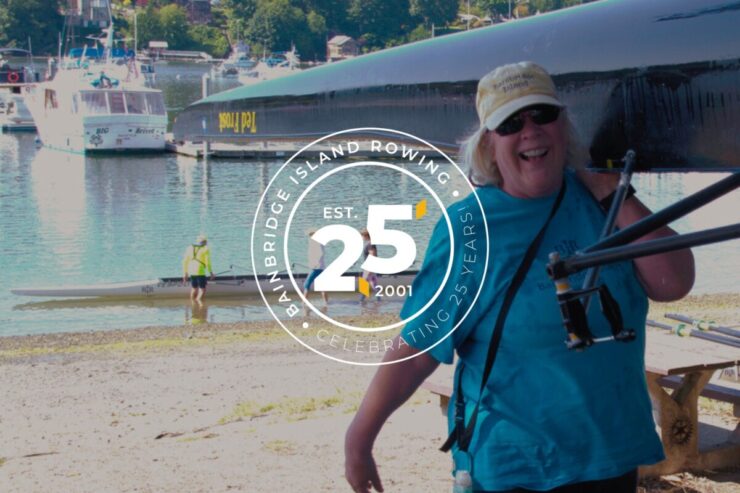
Today, rowing is part of her life in a way she never imagined. “Who’d have guessed that rowing and the rowing community would become so important to this stout, unathletic woman of a certain age? I’ll never be the world’s greatest rower. I don’t seem to have the ‘go faster’ gene. But I love the glory of being on the water on a fine day (or even not so fine), the zen of trying to perfectly match the stroke in front of me, and pausing to admire a siege of herons, watch the seagulls’ morning breakfast meeting, or chuckle at my seal escort.”
She has watched BIR grow, Learn to Row classes expanding and the community deepening, and none of it surprises her. “A more gracious and welcoming community would be hard to find.”
And she still carries with her one of Linda DeRosiers’ favorite lines. “Rowing is the most fun you can have sitting on your butt.”
For Chapple, that joy and the community that surrounds it is exactly what BIR has given her. It is not just a sport she discovered later in life. It is a place where she found belonging, confidence, and a new version of herself she never expected to meet.
“Rowing planted itself at the back of my mind,” Chapple told us. Years later, BIR helped her turn that spark into a whole new chapter of confidence, community, and joy on the water. Her story reminds us that it’s never too late to begin something unexpected.